Wednesday, August 02, 2006

Psychiatry Notes - Biology of Empathy

Biological basis of empathy

Psychological literature tends to focus on the emotional basis of morality. One of the most important affects in determining moral behavior is empathy, an emotional response triggered by the apprehension of another's emotional state and characterized by having feelings similar to what the other is feeling. This ability to perceive another individual's emotions is crucial to our ability to make moral decisions - that is, to make decisions that positively influence others. The neurobiology underlying empathy relies on both targeted and generalized control. Recognition of another's emotional state, a targeted mechanism in that it activates a specific region of the nervous system, appears to rely heavily on right cortical activity. As might be expected, the visual cortex plays a role in recognizing facial expression of emotion, but researchers have also proposed the involvement of right-hemisphere somatosensory cortices, the region of the brain responsible for interpreting sensory input from one's own body. Adolphs, et al., found that subjects with lesions in this region of the brain were less able to recognize emotions, and hypothesized that to recognize an emotion in another individual, the brain simulates the response it would have if one's own face were exhibiting the features seen on the other person. To the extent that empathy drives moral behavior - or, in very basic terms, to the extent that we choose to act in ways that make others happy because we know how it feels - this somatosensory response may offer a partial neurobiological mechanism for moral behavior.

Emotional responses also rely on generalized mechanisms, those that have a broad-based effect on the nervous system. Empathy, as well as the negative motivators of guilt and shame, derive most directly from the balance of neurotransmitters. Empathy has been associated with increased levels of serotonin, an effect that can be seen in response to antidepressant medication and, even more dramatically, to the illicit drug Ecstasy. Similarly, guilt and shame are often accentuated in subjects found to have low levels of serotonin - those suffering from depression, for example. Both provide possible biological explanations of moral behavior.

Beyond the emotional aspect of morality, however, is a decision-making ability crucial to prosocial behavior. This points to a frontal lobe involvement. Indeed, the most famous case of antisocial behavior is that of Phineas Gage, a 19th-century railroad foreman who suffered severe frontal lobe damage as a result of physical trauma. An explosion caused a 3.5-foot iron rod to pass through the left ventromedial region of Gage's frontal lobe. As a result, the once social and placid Gage became impatient, unrestrained, and inconsiderate. He began exhibiting behavior that was, if not immoral, certainly not acceptable. The interesting implication of Gage's experience is that, rather than being actively promoted, moral behavior may be the result of cortical inhibition of certain behaviors. That's an attractive proposition because it makes morality seem just like a lot of other nervous system functions; much of the job of the motor cortex is to inhibit action, for example. This makes morality seem almost routine in terms of neurological function.

To the extent that morality describes behavior towards others, a sense of self - and a sense of others' selves - is also necessary. Without an understanding of our individuality and the effect that our behaviors have on other individuals, moral judgement would be impossible. With this in mind, we may propose an additional purpose for the so-called I-function, that ability of the neocortex to create awareness, experience, and self. The I-function may allow us to make moral decisions by creating awareness of emotion and enabling us to predict and project emotions. This may well be a secondary evolutionary benefit of the I-function, but in a social species such as humans, it can well be imagined that this could have conferred a survival advantage; ostracism for immoral behavior could well have meant death for early humans.

This may work well to explain social morality, but what of behaviors that affect only the individual? As an example, why do some people consider sexual fantasies immoral? As long as no action is taken, thoughts can have no impact on others, yet in the Western cultural tradition, impure thoughts are a significant moral issue. This is probably best described by a cognitive approach. A few schools of thought exist to explain the development of morals. Among cognitive psychologists, Lawrence Kohlberg's model, developed in the 1950s, is still the basis for understanding. In this scheme, moral development is described as a progression through three levels, each with two stages. Justification of moral behavior is seen to move from self-interest (punishment and reward) through social approval (being liked by others and following a prescribed social order) to abstract ideals (obligation of proper behavior and universal rights). This model, though, has been criticized for failing to predict people's actual behavior, despite its usefulness in assessing intellectual development.

Of course, even if it were entirely successful in predicting behavior, there is nothing magical about this cognitive theory of morality. In fact, this fits well with our current understanding of the function of the nervous system and brings morality further into the realm of behavior explicable from a biological standpoint. What Kohlberg describes as moral development is distinct from moral behavior itself. The explanation that an individual provides for why he won't perform some immoral act surely does change with time and maturity, but these reasons are self-reported. That is, it is the I-function - the conscious part of the nervous system - that offers the explanation. If, as has been proposed, the principal role of the I-function is to build models to understand the rest of the nervous system, then it stands to reason, and common experience confirms, that the model may change with new experiences. This does not, however, imply that the actual reason for moral behavior changes, only that our understanding of it does. This may very well mean that, if the understanding changes to incorporate abstract ideals, certain entirely private behaviors will be considered immoral. The underlying cause of moral behavior, though, may still be innate and unconsciously biological at its core.

It has also been proposed that morality is a learned behavior. Children, this model suggests, gain an understanding of right and wrong through "observation, imitation, and reward". Moral behavior, in this case, depends on external instruction and the presence of a reward. It is without a doubt true that specific elements of a moral code are learned; it has never been the contention that all of morality is innate, only that the basic aspects of it are. That morality may be the result of a simple external-stimulus learning process raises some intriguing implications, though. In general, it means that moral behavior may not be as special as we think it is. It has been demonstrated that a simple algorithm can cause a computer to learn to distinguish between two categories. It is a small jump indeed, then, to say that a computer could be taught to distinguish between immoral and moral, given sufficient feedback. At best, this means moral behavior is merely a result of conditioning; at worst, it means free will should not be an issue in assessing whether an act is moral: if a computer, which does not have free will, can be taught to behave "morally," why should we make free will a condition for determining morality?

Behavior, though, is almost always a combination of innate properties and conditioning. If morality, then, is more than conditioning, what evidence do we have that it is innate? First, infants appear to exhibit empathic abilities, responding with tears when someone close is upset and with sounds of pleasure when someone close is happy. Again, empathy's role in moral behavior may be a secondary evolutionary development; the ability to perceive another's emotions is a useful survival tool, since the other individual may be aware of some threat that you aren't. This is primarily speculation, but it does offer a plausible justification for having empathy - and the moral awareness that stems from empathy - inborn. The other emotions associated with morality - shame, guilt, and indignation - also appear early in a child's development.

Indignation is of particular interest in considering a biological basis of morality. William Damon, in his article on childhood moral development, writes, "...young children can be outraged by the violation of social expectations, such as a breach in the rules of a favorite game...." He goes on to note that this sort of response appears in every culture. This points to two salient features of moral behavior. First, it demonstrates that morality is again consistent with our understanding of the function of the nervous system. The nervous system is constantly evaluating input and comparing it to expectations; generally, most input is ignored by the I-function, but when input doesn't match expectations, the nervous system alerts the conscious and some sort of response is triggered. It has been theorized that this is the root of discomfort and pain, and even of phantom-limb syndrome. Here, now, we see that moral indignation falls conveniently into that pattern.

This, in turn, suggests the second salient feature of moral behavior: that morality is a method of ordering the world outside the nervous system. One of the major functions of the nervous system in general and the I-function in particular is to build useful predictive models of the world and our response to it. Being able to predict events is clearly advantageous, in a social context as well as in a natural context - again, evidence and justification that a sense of moral order is innate.

Even evolutionary biology weighs in on the issue. Animals can display what we might call moral behavior, although the term in biology is "animal altruism." The fish that swim toward a predator, the birds that sound a warning call, the whales that help an injured member of the pod, all display behavior that is apparently beneficial to others but costly to themselves. Biologists explain this either in terms of game theory, in which it can be shown that cooperation leads to a higher total payoff in the long run than selfishness, or kin selection, in which the majority of the recipients are related to the altruist and thus pass along some part of the altruist's genome. Most humans would probably like to draw a distinction between the altruistic behavior displayed by animals and moral behavior displayed by humans, and certainly, the same sort of decision-making does not go into animal behavior as goes into human behavior. Ultimately, though, we are subject to the same evolutionary pressures, and it seems reasonable that human moral behavior is closely related to animal altruism. We may not think that we make moral decisions so as to receive a favor in kind, but the impulse to behave morally may well have evolved as a result of that type of pressure. After all, daily human behavior is rife with motivations that we don't actually understand.

The observation that infants, animals, and computers can all display what looks like moral behavior forces us to revisit the question of whether free will is a necessary condition of moral judgement. This argument is not that free will does not exist; for a demonstration that we can choose behaviors, see Grobstein. Rather, it's that free will is not a sufficient criterion to distinguish between moral/immoral and amoral behaviors. Furthermore, it is impossible to determine by observation whether free will is being exercised - or in other terms, whether the I-function is being involved - even in other humans. It seems, then, that all behavior must be categorized either as moral/immoral or as amoral, outside the bounds of morality. This conclusion has profound implications for, as an example, the punishment of apparently immoral behavior by actors who cannot be determined to be capable of moral "decisions" - that is, the youthful or the criminally insane.

That humans, and possibly non-human animals, have an innate sense of morality seems clear. At the very least, the rudiments of the emotions and social understanding that underlie morality are inborn, being displayed from an early age and across cultural divisions. Moreover, morality is easily understood in terms that the rest of neurobiology is understood: the attempt by the I-function to form useful models of the external world, the comparison of expectations to input, even the evolutionary advantage (both directly and indirectly through social interaction) that morality confers. This says nothing about whether morality is absolute, however. The distinction between the propensity for moral behavior and a codified morality must be well understood here. Specific behaviors are ultimately judged to be moral or immoral as a result of personal and cultural conditioning. Using this approach, then, it cannot be said that morality is absolute. Even more generally, it cannot be said that there exists a universal moral code, for that implies a morality inherent in nature. Even if we were to accept as absolute the propensity for altruistic morality, this cannot be extended to natural law. Indeed, it seems even less likely that morality exists throughout nature than that it exists throughout humanity. Life, as we all know, just is not fair.

(Source)

Monday, July 31, 2006

Psychiatry Notes- Childhood Schizophrenia

CHILDHOOD ONSET SCHIZOPHRENIA

CLASSIFICATION:
Very early onset- before 13 yrs of age, Insidious Onset
Early onset , -before 18 years.Acute to subacute onset, i.e within one year

SYMPTOMS
Hallucinations, There are more of hallucinations, both visual and auditory. Misreprentation of normal intrapsychic experience, imagination, dissociative experiences or plainly not understanding the examiner’s question.
Thought Disorder- Commonly seen, Rule out developmental delays or Language disorders.
Flattened affect – common

Generally when evaluating a child for Schizophrenia the child’s age has to be taken into account. The child at the earlier years before age of 7 – 8 may have fantasy friends, this may generally not be of concern to the parents.
If the child demonstrates strange experiences after that age, especially voices passing derogatory remarks, or conversing with each other or seeing scary visual images as well as a decline in their social interaction, esp. staying away from friends, then this may be suggestive of signs of schizophrenia. Remember that since the child’s cognitive framework has not developed well it is very rare that you find them having well systematized delusions. They generally comprise childhood themes.
Incidence: 1 in 40,000, compared to 1 in 100 in adults.

Differential Diagnosis:
Mood Disorders: 50% bipolar chlldren originally diagnosed as schizophrenia
Increased family history of depression in young schizophrenics

Schizoaffective Disorder

Nonpsychotic Behavioural Disorders- they have lower rrates of delusions & thought
disorder. Children who have been victims of abuse may sometimes claim to hear voices of or see visions of the abuser.

Pervasive Developmental Disorder:Earlier age of Onset (Schiz- age of onset 7 years or older) Autism is usually diagnosed by age 3yrs
No normal period of development
Generally lack of hallucinations and delusions
Deviant language patterns
Problems with social relating

Language and Speech Disorders: May mimic thought disorders
Organicity: R/O Seizure Disorder
CNS Lesions- head trauma, tumors
Delirium
Neurodegenerative Disorders- Huntington’s, Lipid Storage, etc

Medications: Amphetamines, Anticholinergics

Metabolic- Wilson’s

Prognosis is poor as compared to adult onset schizophrenia.

The newer generation "atypical" antipsychotics, such as olanzapine and clozapine, may also help improve motivation and emotional expressiveness in some patients. They also have a lower likelihood of producing disorders of movement, including tardive dyskinesia, than the other antipsychotic drugs such as haloperidol. However, even with these newer medications, there are side effects, including excess weight gain that can increase risk of other health problems.
Families can also benefit from supportive counseling, psychotherapies and social skills training aimed at helping them cope with the illness. They likely require special education and/or other accommodations to succeed in the classroom.

Wednesday, July 26, 2006

Psychiatry notes - schizophrenia questionnaire

PRIME questionnaire for Schizophrenia

Actually I owe this Questionnaire to Schizophrenia.com. This free and anonymous screening test for early symptoms of schizophrenia is part of a research study being performed by Yale University Medical School. The PRIME screening test was developed by Dr. Tom McGlashan, Dr. Tandy Miller, Dr. Scott Woods and the PRIME group in the psychiatry dept. of Yale Medical School. I feel it is a very useful tool for the common man who is terrified if they’re going crazy. The site can be accessed and ratings can be done immediately. There is no worry because this site keeps all information anonymous and there is no need to reveal identities.

The following questions are posed and the person is rated on various levels of agreement(definitely disagree to definitely agree at the ends of the spectrum).

1. I think that I have felt that there are odd or unusual things going on that I can’t
explain.

2. I think that I might be able to predict the future.

3. I may have felt that there could possibly be something interrupting or controlling my thoughts, feelings, or actions.

4. I have had the experience of doing something differently because of my superstitions.

5. I think that I may get confused at times whether something I experience or perceive may be real or may be just part of my imagination or dreams.

6. I have thought that it might be possible that other people can read my mind, or that I can read other’s minds.

7. I wonder if people may be planning to hurt me or even may be about to hurt me.

8. I believe that I have special natural or supernatural gifts beyond my talents and natural strengths.

9. I think I might feel like my mind is “playing tricks” on me.

10. I have had the experience of hearing faint or clear sounds of people or a person mumbling or talking when there is no one near me.

11. I think that I may hear my own thoughts being said out loud.

12. I have been concerned that I might be “going crazy”.

another count of faces.


People have given me various ranges for this one between 9 and 15, but many happen to be contorted to the extent of being scary. Maybe you could find more than the maximum till now, that's 15.

Is anyone able to find 9 faces- none of my friends have- Maybe you could!


I have never been able to find the 9 faces which have been claimed to be hidden within this general's photograph unless i count the face of a Dog and the Bird??? If any of you manage to catch the 9 human faces do share it with me.I would love not to spend time on this one again.

How many faces are you able to see in this illusion.


Sorry, these faces seem to be mostly unhappy, morbid ones, though i was reminded of Don Quixote immediately among the few valorous faces I was able to catch.

Tuesday, July 25, 2006

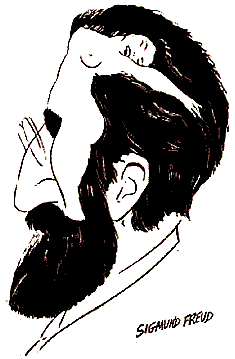
I guess this was always on Freud,s Mind- Can you see the not so obvious???

Psychiatry notes - handwriting analysis

Graphology is a term used for all types of handwriting analysis.On the other hand Graphoanalysis specifically deals with handwriting analysis that can produce sny scintific validation data. Taught by the International Graphonanlysis society its practitioners go by a Code of Ethics.This Society society has over 55,000 graduates and it mainly performs research in the field of Handwriting analysis.Graphoanalysis, therefore, is truly a nonbiased assessment. Analysis of handwriting can neither predict future behavior nor diagnose disease.Graphoanlysis is considered a branch of applied psychology. The analyst deals with a series of personality traits and character that is reflected through various strokes in the Handwriting.

Sunday, July 23, 2006

Psychiatry Notes-graphology in Psychiatry

Alcohol intoxication produces abnormal handwriting with manifestations that are thoroughly described in the literature of forensic science. A less known phenomenon is the peculiar handwriting changes found in alcoholics, especially individuals in the later stages of the disease. In addition to the two handwriting states of non-alcoholic drinkers (normal/sober and intoxicated) the alcoholic writer has a third state, handwriting done in withdrawal. Withdrawal is a state of tension resulting in handwriting characterized by irregularity, ataxia and tremor. This type of abnormal handwriting creates special problems of authentication requiring detailed background history and appropriate comparison specimens, but it can also be used to judge the writer's state of sobriety.
In psychopathology, an interesting approach consists of observing the essential characteristics of already recorded entities. Very few works have been devoted to the rapport existing between graphological productions, personality structure and mental illness. This work concerns the handwritings observed in hysteric patients, diagnosed as such after taking into account case history and clinical interview. Our aim is to show the essential points which characterize this particular pathological structure. The stable features of hysteria are verified in graphic items. From, movement and ordonnance of such handwritings serve as useful aides in identifying the stages of maturation of the Ego. The graphological expressions observed in patients presenting with obsessional neurosis significantly contrast, however, with those encountered in the preceding personality structure (Hy). A comparison of these two different series demonstrate the utility of this work in clinical psychiatry.
(source)

Saturday, July 22, 2006

Psychiatry notes-Choice theory

Choice THeory, Dr.WIlliam Glasser

Choice theory is a new psychology developed by Dr.William Glasser. Dr. Glasser has described how by 1996, he realized that all his psychiatric work was based on people choosing what they do. Hence he decided to give this form of practice a new concept, which he described in Counseling With Choice Theory. The following text is from an abstract by Dr. Glasser. I found the concept very interesting and thought why not share it with everyone…..

“By learning to put choice theory to work in your life, you can improve your relationships with all the people who are important to you. You can also teach choice theory to someone else who then can use it to improve his or her important relationships. Since we are social beings, the need for satisfying relationships is encoded into our genetic structure. The more our genes are satisfied, the healthier we are. Therefore, improving our relationships is improving our mental health.

What I call a psychology is a usual way of dealing with other people in certain situations. For example a car sales person will use a sales psychology when approaching people who come into the showroom. A mother will use a bedtime psychology when she has difficulty putting her children to bed.

Right now all over the world, people rich or poor, of all races, religions and political persuasion use an ancient world psychology which I call external control when they have difficulty getting along with other people, especially people they want to get along well with, usually spouses, family, friends, teachers, fellow students, fellow workers and bosses. This occurs because we live in an external control world. Almost all of what is now wrongly called mental illness can easily be traced back to too much external control.

Even though people who use external control believe it will help them to get along better with the people they use it with, it actually does the opposite. External control will always increase the difficulty between the disagreeing parties. If it is continued it can destroy the relationship it was intended to help. Almost all people who divorce have no idea where their initial, strong, positive feeling for each other has gone. Choice theory teaches this early love was destroyed by one or usually both using external control as the marriage progressed.

External control is destructive because one or both parties will attempt to control the other so the other does what the controlling person wants. If it is used in a marriage, the partners use it on each and other and as they do the marriage goes rapidly downhill. If one partner gets control he or she may be happy but the other will be more miserable and increase his or her resistance. The actual resistance usually starts with anger but most often the anger is changed into depression, anxiety or any of the four hundred plus symptoms that are wrongly diagnosed as mental illness in a book called the DSM-IV. A better title for that book is the big red book of unhappiness. These unhappy people need each other but don’t know how to get along.

Choice theory is the opposite of external control: It is a self- control psychology. Those who practice it have learned that they choose everything they do. They learn they can control their own choices but they can’t control what anyone else chooses. Basically, choice theory explains that whenever we deal with any person we want to get along well with, we should be careful to replace any external control with choice theory.

Specifically, external control leads all who use it to practice the Seven Deadly Habits that destroy relationships. These are criticizing, blaming, complaining, nagging, threatening, punishing or bribing or rewarding to control. Remember once the sentence is out of you mouth you can’t reach out and put it back in. Nor can you erase a look on your face or an upward out-ward roll of your eyes. Choice theory urges all of us to replace the deadly habits with the Seven Caring Habits: supporting, encouraging, listening, accepting, trusting, respecting and negotiating differences.

Keep in mind that the unhappiness caused by our not being able to get along with the people we want to get along with is the basic problem. But unhappiness is not mental illness. Our normal brains are perfectly capable of using external control to the point of suffering any symptom in the DSM-IV. While we may not be mentally healthy, we are not mentally ill. There is nothing wrong with the structure or chemistry of our brains. Learning to put choice theory to work in our lives can bring back happiness or mental health.”

Psychiatry Notes - Autoscopy/Doppleganger

Many famous poets and writers have described autoscopy, sometimes based on their own experiences, like the German poet Goethe. While out in the woods, he thought he recognized himself in someone coming toward him. He perceived himself not through his real, physical eyes, but through the eyes of his soul. Goethe's account is probably the origin of descriptions of autoscopy as having some detached insight (Vondrýcek and Holub, 1968). This factor supports the idea that an extreme narcissism is a specific psychogenic factor here. Patients see themselves either in their contemporary aspect or sometimes older or younger.
Autoskopie, autoscopic hallucinations aussersichsein (to be outside oneself) and doppelsehen (seeing double) are the various terms which describe the experience of an individual seeing themselves.In the past, the term deuteroskopie was sometimes used. The phenomenon is more common in males (Arieti and Bemporad, 1974). Menninger-Lerchenthal, who coined the term heautoskopie, considered this phenomenon to exist primarily as a result of right parietal lobe impairment (Leischner, 1961). He observed one case in the right frontoparietal astrocytoma, and reported on several cases of autoscopy associated with right and left hemisphere damage due to shell injury

Causes: Autoscopic phenomena were described in cases of exhaustion, infection (especially Typhus exanthematicus), epilepsy, migraine, substance abuse or intoxication, and postpartum psychosis (Leischner, 1961).Deep prosopagnosia (impaired facial recognition) could also be a reason for autoscopy. Tranel wrote (1992).

German and Scottish superstitions maintain that seeing one's double is an omen that one will soon die.

Capgras had a female patient in 1923 with the delusion that she was of high noble origin but that, as an infant, she had been switched to another family. She believed that the members of her family had all been gradually replaced by doubles. All of her surroundings and all of her acquaintances were doubles. The patient believed her daughter had 2,000 doubles. The patient believed that in the Parisian underground, 28 million people were kept prisoner, while on the surface only their doubles existed. The patient feared that she herself could be considered to be her own double, and therefore she kept all of her documents on her body (Leischner, 1961).
(source)

Amazing numbers

  • One in five children have a diagnosable mental, emotional or behavioral disorder. And up to one in 10 may suffer from a serious emotional disturbance. Seventy percent of children, however, do not receive mental health services (SGRMH, 1999).
  • Attention deficit hyperactivity disorder is one of the most common mental disorders in children, affecting 3 to 5 percent of school-age children (NIMH, 1999).
  • As many as one in every 33 children and one in eight adolescents may have depression (CMHS, 1998).
  • Once a child experiences an episode of depression, he or she is at risk of having another episode within the next five years (CMHS, 1998).
  • Teenage girls are more likely to develop depression than teenage boys (NIMH, 2000).
  • Children and teens who have a chronic illness, endure abuse or neglect, or experience other trauma have an increased risk of depression (NIMH, 2000).
  • Suicide is the third leading cause of death for 15- to 24-year-olds and the sixth leading cause of death for 5- to 14-year-olds. The number of attempted suicides is even higher (AACAP, 1997).
  • Studies have confirmed the short-term efficacy and safety of treatments for depression in youth (NIMH, 2000).
  • Alcohol, marijuana, inhalants and club drugs are the most frequently used drugs among middle- and high-school youth (SAMHSA, 2000)
  • Research has shown that use of club drugs such as Ecstasy and GHB can cause serious health problems and, in some cases, death. Used in combination with alcohol, these drugs pose even more danger (NIDA, 1999).
  • Children and adolescents increasingly believe that regular alcohol and drug use is not dangerous (SAMHSA, 2000).
  • Among middle- and high-school students, less than 20 percent of young people between the ages of 12 and 17 report using alcohol in the previous month, and less than 4 percent report drinking heavily in the previous month (SAMHSA, 2000).
  • Young people are beginning to drink at younger ages. This is troubling particularly because young people who begin drinking or using drugs before age 15 are four times more likely to become addicted than those who begin at age 21 (SAMHSA, 2000).
  • Children of alcohol- and drug-addicted parents are up to four times more likely to develop substance abuse and mental health problems than other children. (NACOA, 1998)
  • Twenty percent of youths in juvenile justice facilities have a serious emotional disturbance and most have a diagnosable mental disorder. Up to an additional 30 percent of youth in these facilities have substance abuse disorders or co-occurring substance abuse disorders (OJJDP, 2000).

Wednesday, July 19, 2006

Treating depression in tigers!

In a zoo in California, a mother tiger gave birth to a rare set of triplet tiger cubs. Unfortunately, due to complications in the pregnancy, the cubs were born prematurely and due to their tiny size, died shortly after birth. The mother tiger after recovering from the delivery, suddenly started to decline in health, although physically she was fine. The veterinarians felt that the loss of her litter had caused the tigress to fall into a depression. The doctors decided that if the tigress could surrogate another mother's cubs, perhaps she would improve. After checking with many other zoos across the country, the depressing news was that there were no tiger cubs of the right age to introduce to the mourning mother. The veterinarians decided to try something that had never been tried in a zoo environment. Sometimes a mother of one species will take on the care of a different species. The only "orphans" that could be found quickly, were a litter of wiener pigs. The zoo keepers and vets wrapped the piglets in tiger skin and placed the babies around the mother tiger.
(source)

Chocolate-the reasons behind consumption!!!

I found an interesting article examining the reasons behind eating Chocolate, one of my favorite pastimes. I realised i was being categorised into one of 2 kinds of consumers- the cravers and the emotional eaters. Cravers are those who eat chocolate as an indulgent pleasure and emotional eaters are those who use chocolate in a bid to alleviate depression.What more, they even dissected the reason behind wishing for a bite of that brown treat in that anticipating and eating the treat releases 'feel good' neurotransmitters.Chocolate craving, (for the cravers), as an indulgent pleasure seems to stimulate the dopamine system in the brain, and provides an enjoyable experience.However the emotional eaters eat chocolate to relieve boredom, stress or clinical depression and are actually looking for an opioid effect to improve their mood, which is only a temporary relief which is quickly followed by a return to or a worsening of their earlier negative state.

Premenstrual Syndrome

PMS looks more at physical symptoms such as bloating, weight gain, breast tenderness, swelling of hands and feet, aches and pains, poor concentration, sleep disturbance, appetite change, and psychologic discomfort. Premenstrual dysphoric disorder has as part of its definition, symptoms such as depressed mood or dysphoria, anxiety or tension, emotional lability, irritability, decreased interest in usual activities, concentration difficulties, marked lack of energy, marked change in appetite, overeating or food cravings, sleepiness or insomnia, and feeling overwhelmed.The simplest treatments are really simple.First and foremost change in diet can help dramatically. Discontinuance of all caffeine containing products, drinks and over-the-counter medications. A low carbohydrate diet, especially avoiding any simple sugars and only sparingly having complex carbohydrates is beneficial. Calcium supplements (1200 mg/day) also have been shown to help. Vitamin B6 (pyridoxine) has contradictory evidence of its efficacy and progesterone treatment used in the past has been shown to be no better than placebo.

Monday, July 17, 2006

THe Paradox about Tristam Shandy

The Paradox of Tristram Shandy
This paradox, formulated by Bertrand Russell, is based on the 18th century novel TheLife and Opinions of Tristram Shandy, Gentleman, by Laurence Sterne. Here is Russell's statement of the paradox:

"Tristram Shandy, as we know, took two years writing the history of the first two days of his life, and lamented that, at this rate, material would accumulate faster than he could deal with it, so that he could never come to an end. Now I maintain that, if he had lived for ever, and not wearied of his task, then, even if his life had continued as eventfully as it began, no part of his biography would have remained unwritten."

Suppose Tristram Shandy continued at the painfully slow rate at which he started, so that he took a full year to write about each day of his life. In spite of this, there is a one-to-one correspondence between each year that he writes in and each day he writes about. Therefore, no matter what day of his life you care to consider, there will eventually come a year in which he will be able to write about it. There is no part of his life that can never be written down. Nevertheless, he gets further and further behind!

It's interesting to reverse this paradox and consider what would happen if Tristram had already been writing for an infinite amount of time. It at first may seem that the two temporal directions might be mirror images of one another. In that case, just as he might begin to write at time t in the original paradox, in the reversed version it would seem he might have finished his task at t. But a little reflection shows that that is impossible. If he had just finished writing his autobiography, then he would have just written about the most recent day of his life. But since it takes him a year to write about each day, he would have had to start writing about this most recent day 364 days before the day started! Thus, unless Tristram can foretell the future, he cannot have finished writing yet, even though he has already spent an infinite amount of time on the task.

Suppose Tristram has in fact been writing forever and has just finished describing another day. When might have been the day he just finished writing about? As we've just seen, he could not have been writing about today, for he would have had to start writing about it a year ago. So it seems that the most recent day he could have been writing about is a year ago today. But then what was he writing about in the previous year? He would have been writing about a year ago yesterday. But that too is impossible, for he would once again have had to start 364 days too soon. Repeated application of this argument shows that, no matter what date in the past one chooses, Tristram could not already have written about it. He therefore can only have finished writing about a day that lies in the infinitely remote past!
(Source)

Who's the tallest of the 3 figures?

Well, well,......they're all the same size. I know it is hard to believe, but its true. I actually measured them.

Sunday, July 16, 2006

How the tables have turned now in three years

I read an article while surfing thru the net, which featured in The Times Of India, Saturday 1 November 2003,

But fortunately or unfortunately it’s a whole different situation now as in 2006, 3 years later. Britain seems to have got smart and changed so many rules that many doctors from the UK have packed their bags and come back for good.

After teachers and nurses it’s the psychiatrist’s turn to get lured by the Queen’s own country, UK.Along with Mumbai, Bangalore and Hyderabad the trend is taking Pune in its wings with doctors saying the English want more. Britain ’s National Health Service has been openly accused of indulging in the “Great Brain robbery”.

According to statistics from the London School of Hygiene and Tropical Medicine, India has one psychiatrist per 30,0000 population in comparison to one per 90,000 population in UK . From which, Maharashtra has approximately 500 psychiatrists, while the number of psychiatrists in Pune stands at about 80, who according to the latest reports have been bitten by the UK bug. When there is an excess of manpower in any particular field, a foreign Government can take permission from the domestic Government to advertise for jobs. That’s what the British Government has been doing for the last couple of years. The brain drain could be attributed to this. Moreover, applicants can now also do the procedure on-line through the department of Health UK .But the process is anything but easy, and involves years of experience, several credentials, a good amount of research and various levels of screening to then finally be UK bound.


Psychiatry Notes - First Psychaitric Hospital In India

It is worthwhile to trace the beginning of general hospital psychiatry in India, my country.
During the early decades of the 20th century a movement was initiated, first in the USA and then in the UK to improve the quality of care for mental illness and to disseminate knowledge about mental health amongst the masses. In order to organize this movement a National Committee for Mental Hygiene was established in the USA in 1909. This was followed by the formation of a Mental Hygiene Council in the UK in 1923. The educated and the enlightened people of all walks of life were enrolled as members of these organizations. The impact of their activities was felt on the shores of India very soon. On active encouragement from the Mental Hygiene Council (UK), the Indian Association for Mental Hygiene came into being at Simla on 23rd August 1928. The membership of the association was open to all who subscribed to its aims and objectives and participated in all activities towards their implementation. Lt. Col. Owen Berkeley – Hill, Superintendent of the then European Lunatic Asylum, Ranchi (now known as Central Institute of Psychiatry) was elected as its first President. The aims and objectives of the association, as attributed by its President, were as follows –

To disseminate the knowledge about mental hygiene amongst masses

To organize meetings, seminars and popular lectures on mental health and mental illnesses

To establish a library for storing and distributing books on mental health and allied disciplines

Publication of a quarterly Bulletin of the Association

Establishment of treatment centers for mental illnesses.

The Calcutta Chapter of the Association was opened sometime in late 1929. Dr. Girindra Sekhar Bose, who was the Founder President of Indian Psychoanalytical Society (established in 1922) and the then head of Department of Psychology, Calcutta University was a leading member of the Association at Kolkata. The Calcutta Chapter, under the leadership of Dr. Bose, took an active part in implementing the rather ambitious plan of the Association. From a small beginning (with five founder members) this subcommittee of the Association grew in size rapidly. In course of less than four years, by the beginning of 1933, its membership rose to 264.

The Calcutta Chapter arranged a monthly popular lecture on mental health delivered by a leading scholar of the city. It became so popular and attractive that, on public demand, the monthly event soon became a weekly event.

Emboldened by this favorable public response, the Association decide to establish a home for the Mentally Retarded for their custody, care, and training. Support in the form of money, land and voluntary expert service came readily and the Home was established on 24th April, 1932. The name of the Home – BODHANA NIKETAN – was coined by none other than the Nobel Laureate poet Rabindranath Tagore.

The next step taken by the Association was the opening of a psychiatric outpatient clinic in a general hospital. The far-reaching impact of this act outlived the association itself. The State Government was approached for assistance in this endeavor. It was proposed by the Association that adequate room be made available in the Calcutta Medical College (a state-run institution) for the Clinic. The initial response was positive, but very soon it was made clear by the Government that the time was not yet ripe for it. Thereupon, the Association, under the leadership of Dr. Girindra Sekhar Bose, persuaded the authority of Carmichael Medical College, Calcutta – then run by a non-profit-making private organization – to allow it to open a psychiatric outpatient clinic in the college premises (this private college was taken over by the State Government in free India). It was agreed that the Association would pay for the expenses of the clinic. The College authority, however, lent some furniture and arranged for supply of free electricity. Dr. Bose made an advance of Rs. 867.50/- to defray the cost of furnishing the Clinic and purchasing some essential instruments. Thus the stage was set for opening the doors of the first psychiatric OPD clinic in a general hospital in India.
The first department of psychiatry with outpatient facility in a general hospital in India was opened on 1st May 1933 at the then Carmichael Medical College (now known as R. G. Kar Medical College). Kolkata. In 1938, the outpatient facility of Department of Psychiatry of J.J. Hospital, Mumbai was opened.A department of Neurology and Psychiatry was established in the Calcutta Medical College in 1939 by an order of the Government of Bengal.

A few interesting details about this Clinic-

The working hours of the Clinic was between 8-00 AM and 10-00 AM on every Tuesday and Thursday. The MO-in-Charge was Dr. Girindra Sekhar Bose. He had two other M.O.’s to assist him. They were Dr. Bhupati Mohan Ghosh and Dr. Kamakhya Charan Mukherjee. All the members of the staff worked on honorary basis. The sole exception was a part-time bearer who received a monthly pay of Rs. 2/- (Rupees Two only).

Though the OPD clinic was opened on 1st May, 1933 the first patient was registered on the following day i.e. 2nd May, 1933. The original case record of this patient is still preserved and displayed on the wall of the chamber of the Head of the Dept. of Psychiatry of R.G. Kar Medical College.

It is on record that 174 new cases attended the clinic during the first year of its existence. It is gratifying to note that this clinic is not only the first of its kind but is still one of the most thriving centers of service, teaching and research in Psychiatry in Kolkata.


Saturday, July 15, 2006

Napolean???Haemorrhoids


I read this funny article citing that one of the problems at Waterloo may have been Napoleon's haemorroids.Allegedly he did suffer from very painful hemorrhoids which troubled him riding a horse in the battlefield.If you are a type A individual, you frequently develop hemorrhoids.